What is the difference between testosterone cypionate and enanthate?
The short answer: testosterone cypionate vs enanthate is a comparison of two esters of the same hormone, and for most men on TRT the choice is close to a coin flip. Cypionate carries an 8-carbon cyclopentylpropionate ester; enanthate carries a 7-carbon heptanoate ester. That single extra carbon makes cypionate slightly more fat-soluble, which is why its FDA label lists a half-life of about 8 days while enanthate is typically cited at 4 to 5 days. When both are injected at the same dose on the same schedule, the resulting serum testosterone curves are so similar that the one direct crossover study could not separate them.
The differences that actually affect a patient are practical rather than pharmacological: cottonseed oil versus sesame oil, which preservative is in the vial, whether the pharmacy has it in stock, what the insurer covers, and the fact that the only FDA-approved subcutaneous testosterone auto-injector (Xyosted) happens to be enanthate. Everything else people attribute to the ester — smoother levels, less estradiol, fewer mood swings — is really a function of dose and injection frequency.
This guide walks through the ester chemistry, where the half-life numbers come from, the single-injection pharmacokinetic data, the dosing ranges in the FDA labels and guidelines, and the vehicle and cost differences. It is educational content for understanding your prescription, not a substitute for your prescriber's judgment. For the broader picture of how injectables compare with gels, pellets, and oral products, start with the TRT delivery methods guide.
Educational disclaimer: Testosterone cypionate and enanthate are Schedule III controlled prescription medications. The dosing ranges in this article are quoted from FDA labels and published guidelines to explain how the products are studied and prescribed; they are not a recommendation for any individual. Do not start, stop, switch, or adjust a testosterone product without a licensed prescriber and appropriate blood work.
Side-by-side comparison
This TRT ester comparison pulls the key facts from the FDA labels (Depo-Testosterone vs Delatestryl and its generics) and the pharmacokinetic literature into one table. The rows where the two columns differ are the ones worth reading closely; most of them are about the vial, not the hormone.
| Feature | Testosterone cypionate | Testosterone enanthate |
|---|---|---|
| Ester | Cyclopentylpropionate (8 carbons, ring structure) | Heptanoate (7 carbons, straight chain) |
| Nominal half-life | ~8 days (Depo-Testosterone label) | ~4-5 days (Behre & Nieschlag PK analyses) |
| Testosterone per 100 mg ester | ~70 mg | ~72 mg |
| Peak after 200 mg IM | Days 2-5 (Nankin 1987) | 24-48 hours (Snyder 1980) |
| Back near baseline | Days 13-14 | About 2 weeks |
| FDA-label dosing | 50-400 mg IM every 2-4 weeks | 50-400 mg IM every 2-4 weeks |
| Endocrine Society 2018 regimen | 75-100 mg weekly or 150-200 mg every 2 weeks | 75-100 mg weekly or 150-200 mg every 2 weeks |
| Oil vehicle | Cottonseed oil | Sesame oil |
| Preservative / excipients | Benzyl benzoate + benzyl alcohol | Chlorobutanol |
| Concentrations (US) | 100 mg/mL and 200 mg/mL vials | 200 mg/mL vial; Xyosted 50/75/100 mg per 0.5 mL |
| US brand | Depo-Testosterone (Pfizer) + generics | Delatestryl (withdrawn), generics, Xyosted (subcutaneous) |
| FDA-approved subcutaneous product | None (subq use is off-label) | Xyosted auto-injector (2018) |
| Where it dominates | United States | Europe, UK, Australia, most international trials |
| DEA schedule | Schedule III | Schedule III |
What the ester actually does
Plain testosterone injected into muscle is cleared within hours, which is useless for replacement therapy. Attaching a fatty acid to the hydroxyl group at the 17-beta position of the molecule — creating an ester — solves that. The esterified hormone dissolves in the oil vehicle, forms a depot in the muscle, and leaks out slowly. Once it reaches the bloodstream, enzymes called esterases cleave the fatty-acid chain off and release native testosterone. The ester itself is biologically inert; only the freed testosterone acts on receptors.
Two things about the ester chain determine how a preparation behaves:
- Chain length and lipophilicity. Longer, bulkier chains are more fat-soluble, so they stay in the oil depot longer and release more slowly. Propionate (3 carbons) lasts a couple of days. Enanthate (7 carbons) and cypionate (8 carbons) last one to two weeks. Undecanoate (11 carbons) in castor oil lasts months.
- Molecular weight. The ester adds mass without adding hormone. A milligram of testosterone cypionate contains less actual testosterone than a milligram of enanthate, because the cypionate chain is heavier. The difference is small — about 70 mg versus 72 mg of testosterone per 100 mg of ester — but it explains why "100 mg" on two different vials is not perfectly identical.
Testosterone fraction = 288.4 ÷ ester molecular weight. The cypionate-enanthate gap is about 3%, small enough that prescribers switch milligram for milligram.
Half-life: where the cypionate and enanthate numbers come from
The testosterone ester half-life figures repeated across TRT forums — 8 days for cypionate, 4.5 days for enanthate — are real, but they were never measured side by side, and treating them as a precise ranking overstates what the data show.
- Cypionate half-life. The Depo-Testosterone prescribing information states plainly: "The half-life of testosterone cypionate when injected intramuscularly is approximately eight days." That sentence is the source of nearly every "8 days" citation online.
- Enanthate half-life. The generic enanthate label gives no number at all. The 4-5 day figure comes from the pharmacokinetic modeling of Behre and Nieschlag (published in their comparative reviews of testosterone esters), who also reported a mean residence time of about 8.5 days for enanthate.
The important caveat: those two numbers were derived from different men, different doses, different assays, and different curve-fitting methods decades apart. A terminal half-life from a modeled elimination phase is not the same quantity as a label statement summarizing depot release. The chart below puts the commonly cited figures for all four clinically relevant esters on one scale.
Values are approximate and were derived in separate studies with different methods. The cypionate-enanthate gap looks large on paper but disappears at clinical dosing intervals.
The one head-to-head study
Only one published trial has injected both esters into the same men and compared the curves. Schulte-Beerbühl and Nieschlag (Fertility and Sterility, 1980, PMID 7353699) measured serum testosterone, dihydrotestosterone, LH, and FSH after intramuscular testosterone enanthate and testosterone cypionate. The hormone profiles overlapped closely enough that the authors could not identify a clinically meaningful difference between the two esters. That finding, not the label half-life, is the reason endocrinology texts describe cypionate and enanthate as functionally interchangeable.
Why does a nominal 8-day versus 4.5-day difference wash out? Because the depot release from oil, not the elimination of free testosterone, is the rate-limiting step, and both esters are lipophilic enough that the oil depot governs the curve. Once you are injecting weekly or twice weekly — the norm in modern TRT — each new dose arrives long before the previous one has cleared, and the steady-state fluctuation is set by the interval, not by the ester.
What happens after a single 200 mg injection
The classic pharmacokinetic studies of both esters used the 200 mg every-two-weeks regimen that was standard in the 1980s. Their findings still describe what happens inside each dosing interval today.
- Cypionate — Nankin, Fertility and Sterility 1987 (PMID 3595893). In 11 hypogonadal men, 200 mg of intramuscular testosterone cypionate produced a threefold rise in serum testosterone with peak values on days 2 to 5, a 4.5-fold rise in free testosterone peaking on days 2 to 3, and a threefold rise in estradiol. Many men exceeded the normal range between days 2 and 7, then steroid levels "declined to basal levels by days 13 to 14." Shoskes and colleagues (Translational Andrology and Urology, 2016) summarize the mean peak in that dataset as 1,112 ± 297 ng/dL.
- Enanthate — Snyder and Lawrence, JCEM 1980 (PMID 6777395). Twenty-three men with primary hypogonadism were treated with 100 mg weekly, 200 mg every 2 weeks, 300 mg every 3 weeks, or 400 mg every 4 weeks. Average peak concentrations exceeded 1,200 ng/dL within 24 to 48 hours of injection on every regimen; after the 200 mg dose, levels plateaued near the lower limit of normal at two weeks. The 300 mg and 400 mg regimens fell below the normal range before the next injection.
- Enanthate — Sokol et al., Fertility and Sterility 1982 (PMID 6800853). A 200 mg enanthate injection maintained eugonadal testosterone and estradiol through day 11 in hypogonadal men; a 100 mg dose held eugonadal testosterone through day 7. The authors recommended 200 mg every 10 to 14 days.
Overlay those descriptions and you get the picture below: an early supraphysiological peak, a decline through the normal range, and a return toward baseline around two weeks — for both esters.
Conceptual illustration, not patient data. Enanthate peaks slightly earlier and cypionate slightly later, but both spend days above the reference range and both approach baseline near day 14.
This is also why the every-two-weeks label regimen fell out of favor. The Endocrine Society's 2018 guideline describes the injectable ester profile bluntly: after a single injection, serum testosterone concentrations "rise into the supraphysiological range, then decline gradually into the hypogonadal range by the end of the dosing interval," with "peaks and valleys in serum T concentrations that may be associated with fluctuations in symptoms." The peak-and-valley problem belongs to the dosing interval, and it is identical for both esters. Our guide on 200 mg per week covers what happens when the weekly total climbs.
Testosterone cypionate dosing vs enanthate dosing: what the labels and guidelines say
The two FDA labels are nearly word-for-word identical on dosing. Depo-Testosterone: "For replacement in the hypogonadal male, 50 - 400 mg should be administered every two to four weeks." Generic testosterone enanthate (Hikma): "As replacement therapy, i.e., for eunuchism, the suggested dosage is 50 to 400 mg every 2 to 4 weeks." Neither label distinguishes the esters by dose, and neither has been updated to reflect how the drugs are actually prescribed.
Modern practice is anchored by two guidelines and the pharmacokinetic studies above:
- Endocrine Society 2018 (Bhasin et al., JCEM, PMID 29562364) lists a single regimen for "testosterone enanthate or cypionate": 75-100 mg IM weekly, or 150-200 mg IM every 2 weeks, with the advantages "relatively inexpensive, if self-administered; flexibility of dosing." The guideline does not treat the esters differently.
- AUA 2018 (amended 2024) (Mulhall et al., Journal of Urology, PMID 29601923) recommends titrating any testosterone product to a total testosterone in the middle tertile of the reference range, roughly 450-600 ng/dL, and confirming with a follow-up level after an appropriate interval.
- Snyder and Lawrence 1980 found that 100 mg weekly and 200 mg every 2 weeks were the enanthate regimens that kept testosterone in range without falling below normal before the next dose — a conclusion that has held up for cypionate too.
In real clinics the trend has moved further, toward weekly or twice-weekly injections of smaller volumes, because splitting the dose lowers the peak and raises the trough without changing the weekly total. That logic applies equally to both esters. The Xyosted label formalizes it for enanthate: 75 mg subcutaneously once weekly to start, adjusted on a trough drawn 7 days after the last dose once 6 weeks of dosing are complete.
Steady state and when to draw labs
A drug reaches roughly 97% of steady state after five half-lives. Taken literally, enanthate's 4.5-day figure implies about 3 weeks and cypionate's 8-day figure about 6 weeks. In practice the Xyosted registration studies observed steady state at week 6 for weekly enanthate, which is why a first follow-up draw at about 6 weeks is standard for both esters regardless of which half-life you believe. The Endocrine Society recommends checking serum testosterone midway between injections for enanthate and cypionate; many prescribers draw at trough (the morning of the next injection) instead. Either is fine as long as the timing is consistent from draw to draw. The full schedule is in our TRT blood work schedule.
Why the half-life debate matters less than it seems. A man injecting 50 mg of cypionate every 3.5 days and a man injecting 50 mg of enanthate every 3.5 days will both build to a steady state in which each dose overlaps the tail of the last several. At that point the peak-to-trough swing is governed by the 3.5-day interval, and the difference between an 8-day and a 4.5-day ester becomes a rounding error in the achieved levels. The ester only shows itself at the extremes: long dosing gaps, a missed dose, or the washout period after stopping.
Oil vehicles, preservatives, and allergies
If the pharmacology is a wash, the formulation is where patients actually notice a difference. The two vials are not the same liquid.
| Component | Depo-Testosterone 200 mg/mL (Pfizer) | Testosterone enanthate 200 mg/mL (Hikma) | Xyosted (Antares) |
|---|---|---|---|
| Oil | Cottonseed oil, 560 mg per mL | Sesame oil | Sesame oil |
| Solubilizer | Benzyl benzoate, 0.2 mL per mL | None listed | None listed |
| Preservative | Benzyl alcohol, 9.45 mg per mL | Chlorobutanol, 5 mg per mL | Single-dose, preservative-free |
| Container | 1 mL and 10 mL multi-dose vials | 5 mL multi-dose vial | 0.5 mL single-dose auto-injector |
| Labeled route | Intramuscular only | Intramuscular only | Subcutaneous only |
Three practical consequences follow:
- Sesame allergy. Sesame became the ninth major allergen under US federal law with the FASTER Act of 2021, effective January 1, 2023. Men with a sesame allergy have a concrete reason to prefer cypionate in cottonseed oil, and the reverse holds for anyone sensitive to cottonseed. Both labels list hypersensitivity as a contraindication; the enanthate label specifically names any of its components.
- Injection-site reactions. Benzyl benzoate and benzyl alcohol are the usual suspects when a patient reports burning, redness, or a firm lump after cypionate shots. Chlorobutanol in enanthate bothers a different (smaller) group. When a reaction is clearly local and recurring, a change of ester is a reasonable thing to raise with the prescriber before assuming the testosterone itself is the problem.
- Viscosity and volume. Both oils are thick enough to draw slowly through a fine needle. Cypionate's benzyl benzoate content makes it marginally thinner, which some patients notice with 27-gauge subcutaneous needles. The 100 mg/mL cypionate strength is convenient for small, frequent doses; enanthate is only available at 200 mg/mL in generic vials.
One reaction that gets attributed to the ester but is actually a vehicle-and-route phenomenon is pulmonary oil microembolism (POME) — the coughing fit some men get seconds after an injection. It is formally documented and monitored for testosterone undecanoate in castor oil (Aveed), which carries a REMS program for it; it is rare with cypionate or enanthate, though isolated case reports exist, and it is one reason to inject slowly as trained.
Does ester choice change TRT side effects?
No. Every systemic side effect of testosterone therapy tracks the amount of free testosterone reaching tissue over time, which means it tracks dose, peak height, and dosing frequency. There is no published evidence that switching from cypionate to enanthate at the same dose and schedule changes estradiol, hematocrit, PSA, blood pressure, acne, or mood in a measurable way. The two labels carry identical class warnings, and both were revised in 2025 to add the same statement that testosterone "can increase blood pressure which can increase cardiovascular (CV) risk over time."
What the ester debate usually stands in for is the peak-versus-trough problem:
- Estradiol. Nankin's cypionate data showed estradiol rising threefold in the days after a 200 mg shot. That spike is a function of the supraphysiological testosterone peak. Splitting the dose flattens it; changing the ester does not. See estradiol on TRT and when an aromatase inhibitor is actually needed.
- Hematocrit. In the 52-week Xyosted enanthate study, increased hematocrit was among the most frequently reported adverse events and, together with hypertension and PSA increases, accounted for the 30 discontinuations — the same profile cypionate produces. The driver is total androgen exposure. Our guide to hematocrit on TRT explains the 54% threshold and management.
- Mood and libido swings. The Endocrine Society attributes these to "peaks and valleys" within the dosing interval. A weekly or twice-weekly schedule addresses them; the ester does not.
- Cardiovascular risk. The 2023 TRAVERSE trial used a transdermal gel, not an ester, and the FDA's 2025 class-wide labeling changes applied to all testosterone products equally. See TRT and cardiovascular risk in 2026.
A pattern clinicians recognize.A patient reports that his mood and energy crash on days 6 and 7 of a weekly 200 mg cypionate injection and asks whether enanthate would be "smoother." The trough labs confirm the pattern: testosterone in the low 300s at day 7 after a peak well above range on day 3. The fix that actually works is not a different ester; it is the same weekly total split into two injections. When his prescriber makes that change, his day-7 trough rises, his peak falls, and the crash disappears — on the same cypionate vial he already had.
Availability, cost, and regional patterns
The strongest predictor of which ester a man ends up on is his zip code, not his physiology.
United States: cypionate country
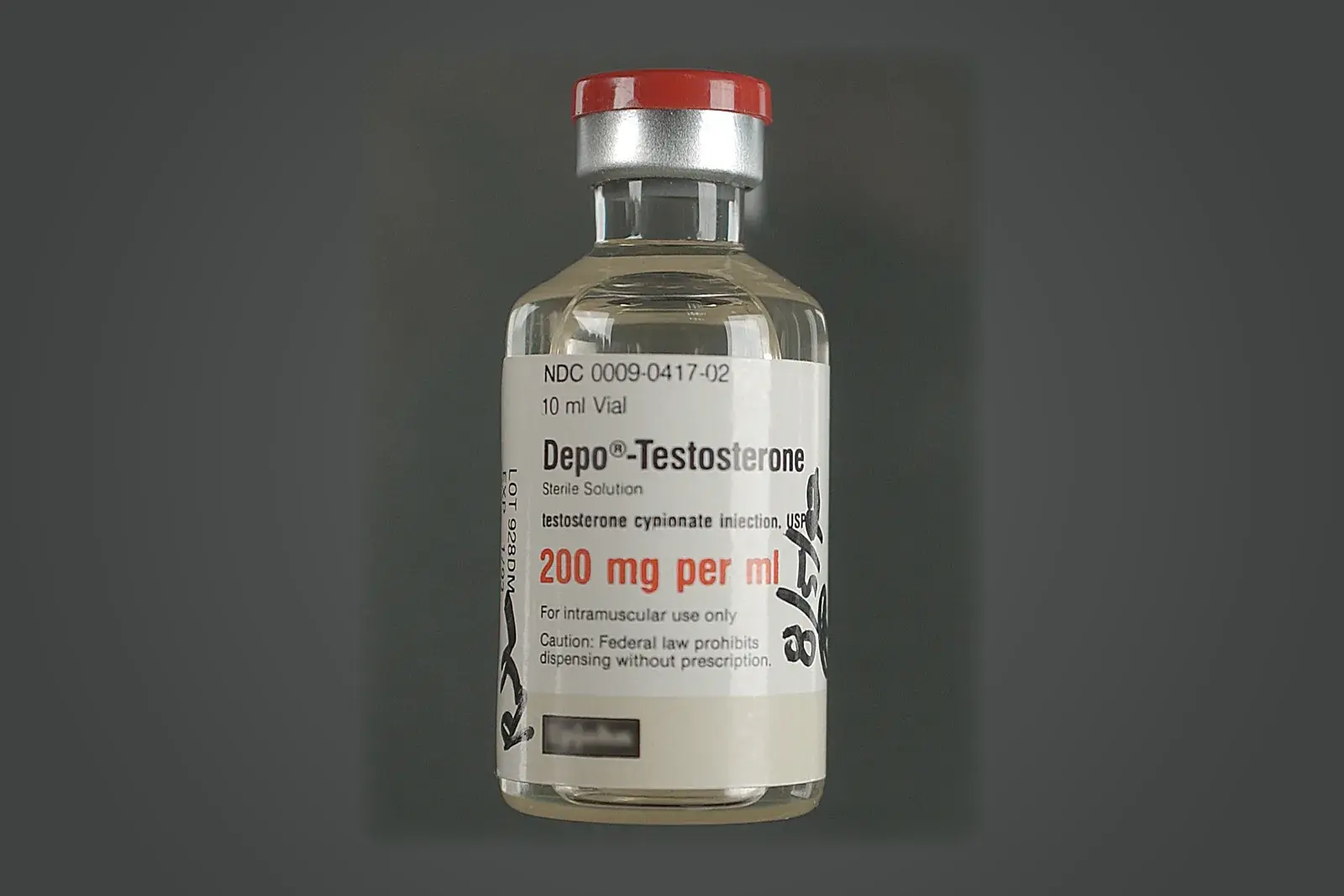
Depo-Testosterone (Pfizer) has been sold in the US since the early 1950s, and its current FDA application (ANDA 085635) was approved in 1979. It is stocked by virtually every retail pharmacy, produced by multiple generic manufacturers in 100 mg/mL and 200 mg/mL strengths, and covered by most insurance formularies. American endocrinologists and urologists trained on it, telehealth TRT clinics default to it, and the American pharmacokinetic literature (Nankin, Shoskes) describes it. Cash prices for a generic multi-dose vial typically run in the tens of dollars with a discount card, and cypionate is usually a few dollars cheaper and easier to find than enanthate.
Europe, the UK, and Australia: enanthate country
Testosterone enanthate was first approved in the US in 1953 (the date Xyosted's label still cites as its initial approval) but found its home abroad under brands such as Testoviron Depot and Primoteston Depot. It is the ester in most European and international trials, including the Snyder and Sokol studies above, and it is the injectable most European guidelines assume. Sustanon, a blend of four esters including propionate and phenylpropionate, fills the same niche in some markets.
Delatestryl, generics, and shortages
The original US enanthate brand, Delatestryl (NDA 009165), has been withdrawn from sale. In an August 2024 Federal Register notice the FDA determined that Delatestryl was not withdrawn for reasons of safety or effectiveness — a routine finding that allows generic enanthate (currently from Hikma and Eugia) to stay on the market. Both esters have cycled on and off the FDA and ASHP drug shortage lists at various points over the past several years, and a shortage of one is the most common reason a patient gets switched to the other.
Why a pharmacist cannot swap them
Under the FDA Orange Book's rules for injectable oil solutions, products are considered therapeutically equivalent only when the active ingredient, its concentration, and the oil vehicle are all identical. Cypionate and enanthate are different active ingredients in different oils, so they are not substitutable at the pharmacy counter. A switch requires a new prescription, which is usually a phone call rather than an appointment.
Xyosted: the premium exception
Xyosted's single-dose auto-injector is priced as a branded product, with list prices running into the hundreds of dollars per month before insurance. It is the only enanthate product that costs materially more than generic cypionate, and the price buys convenience and an on-label subcutaneous route, not a different hormone. Cost comparisons across every delivery method are in the TRT cost guide.
Subcutaneous use: which ester has the FDA-approved product?
Enanthate. Xyosted (testosterone enanthate in sesame oil) was approved in October 2018 as a weekly subcutaneous auto-injector and remains the only testosterone product labeled for subcutaneous administration. Its pivotal data are the strongest modern pharmacokinetic dataset for either ester:
- In the 52-week study (Kaminetsky et al., Journal of Urology 2019, PMID 30296416), 150 men started on 75 mg weekly, adjusted at week 7 to 50, 75, or 100 mg based on the week-6 trough. At week 12, 92.7% had an average testosterone in the 300-1,100 ng/dL range (mean 553 ± 127 ng/dL), 91.3% had a peak under 1,500 ng/dL, and no patient exceeded 1,800 ng/dL. Mean trough at week 52 was 487 ng/dL.
- Serum testosterone peaked a median of 11.9 hours after a subcutaneous dose (per the label), far earlier than the multi-day peak after an intramuscular depot, and then declined slowly across the week.
- In the 26-week safety study (Gittelman et al., Journal of Sexual Medicine 2019), ambulatory blood pressure rose a mean 3.7/1.3 mm Hg at week 12, the finding that originally earned Xyosted a boxed warning. In March 2025 the FDA removed that boxed warning and moved blood pressure increases into the standard Warnings and Precautions section.
Source: Kaminetsky JC et al., J Urol 2019;201(3):587-594. Trial data for the enanthate auto-injector; comparable modern registration data do not exist for vialed cypionate.
Cypionate has no on-label subcutaneous product, but off-label subcutaneous cypionate is common and reasonably well studied. McFarland and colleagues (Journal of the Endocrine Society 2017, PMID 29264562) sampled 11 patients on weekly subcutaneous cypionate at eight points across the dosing week and found mean total testosterone of 627 ± 206 ng/dL with levels "stable and well within the normal range between injections." Whether the route matters more than the ester — it does — is the subject of our subcutaneous vs intramuscular TRT comparison.
Switching between esters: what to expect
Because the two esters deliver almost the same testosterone per milligram and produce nearly the same curve, a switch is usually uneventful. What clinicians typically do, and what patients typically notice:
- The dose stays the same. Milligram-for-milligram is the norm. The 3% molar difference is smaller than the vial-to-vial and injection-technique variability already built into TRT.
- The schedule stays the same. There is no pharmacokinetic reason to inject enanthate more often than cypionate at weekly or twice-weekly intervals. The nominal half-life difference only becomes visible at every-two-weeks or longer gaps.
- Labs are rechecked at about 6 weeks. Total testosterone, sensitive estradiol, and hematocrit at the same draw timing as before. Most men see numbers within their previous range; if something moved, it is more often a change in injection volume or technique than the ester.
- The injection may feel different. The new vehicle and preservative are the most common source of a noticeable change — less (or more) post-injection soreness, a different viscosity through the needle. Persistent lumps or redness warrant a call to the prescriber.
- The prescription must be rewritten. The pharmacy cannot substitute. Check concentration carefully: a man used to drawing 0.5 mL of 100 mg/mL cypionate who receives 200 mg/mL enanthate needs to draw half the volume.
Concentration errors are the real switching risk. The ester change is pharmacologically trivial; the vial-strength change is not. Because cypionate is sold at both 100 mg/mL and 200 mg/mL while generic enanthate comes only at 200 mg/mL, a switch is a common moment for accidental double or half dosing. Confirm the concentration on the new vial and recalculate the draw volume with your prescriber or pharmacist before the first injection.
Who should choose which?
For most men, the honest answer is "whichever one your prescriber and pharmacy can reliably supply." A few situations tilt the decision:
Cypionate tends to make more sense if you:
- Are in the United States and want the most widely stocked, lowest-cost generic
- Have a sesame allergy or have reacted to a sesame-oil product
- Want the 100 mg/mL strength for small, frequent, low-volume injections
- Are already stable on it (there is no benefit to switching a well-controlled patient)
Enanthate tends to make more sense if you:
- Want an FDA-approved subcutaneous auto-injector (Xyosted) and your insurance covers it
- Have reacted to benzyl benzoate or benzyl alcohol, or to cottonseed oil
- Live in or travel frequently to a country where enanthate is the standard supply
- Are switching because cypionate is on shortage at your pharmacy
If your reason for considering a switch is smoother levels, less estradiol, or fewer mood swings, the ester is the wrong lever. Ask about dose and frequency first. And if the question is whether to inject at all, our comparisons of gel vs injections, pellets vs injections, and the three oral testosterone undecanoate products cover the alternatives.
The bottom line
Testosterone cypionate and testosterone enanthate are two esters of one hormone, separated by a single carbon atom. Cypionate's label half-life is about 8 days and enanthate's cited half-life is 4 to 5 days, but those figures were derived separately, and the only direct crossover found the serum curves effectively identical. Both peak above the normal range within days of an intramuscular injection and return toward baseline around two weeks, which is why both labels say 50-400 mg every 2-4 weeks and why the Endocrine Society gives them one shared regimen.
The differences a patient can actually feel are in the vial, not the molecule: cottonseed oil with benzyl benzoate and benzyl alcohol for cypionate, sesame oil with chlorobutanol for enanthate; 100 and 200 mg/mL strengths for cypionate, 200 mg/mL for generic enanthate; near-universal US availability for cypionate, the only on-label subcutaneous product (Xyosted) for enanthate. Side effects, stability, and results are set by dose and injection frequency, and they do not change when the ester does.
Whichever ester you use, the fundamentals are the same: a confirmed diagnosis, a dose titrated to a mid-range target, consistent draw timing, and regular blood work for testosterone, estradiol, and hematocrit. For pillar context, see the TRT 101 overview.
Sources referenced in this article:
- Schulte-Beerbühl M, Nieschlag E. "Comparison of testosterone, dihydrotestosterone, luteinizing hormone, and follicle-stimulating hormone in serum after injection of testosterone enanthate or testosterone cypionate," Fertility and Sterility (1980). PMID 7353699, DOI 10.1016/s0015-0282(16)44543-7.
- Nankin HR. "Hormone kinetics after intramuscular testosterone cypionate," Fertility and Sterility (1987). PMID 3595893.
- Snyder PJ, Lawrence DA. "Treatment of male hypogonadism with testosterone enanthate," Journal of Clinical Endocrinology & Metabolism (1980). PMID 6777395, DOI 10.1210/jcem-51-6-1335.
- Sokol RZ, Palacios A, Campfield LA, Saul C, Swerdloff RS. "Comparison of the kinetics of injectable testosterone in eugonadal and hypogonadal men," Fertility and Sterility (1982). PMID 6800853.
- Shoskes JJ, Wilson MK, Spinner ML. "Pharmacology of testosterone replacement therapy preparations," Translational Andrology and Urology (2016). PMID 27785424.
- Behre HM, Nieschlag E. "Comparative pharmacokinetics of testosterone esters," in Nieschlag E, Behre HM (eds), Testosterone: Action, Deficiency, Substitution, Springer.
- Bhasin S et al. "Testosterone Therapy in Men With Hypogonadism: An Endocrine Society Clinical Practice Guideline," JCEM (2018). PMID 29562364, DOI 10.1210/jc.2018-00229.
- Mulhall JP et al. "Evaluation and Management of Testosterone Deficiency: AUA Guideline," Journal of Urology (2018, amended 2024). PMID 29601923.
- Kaminetsky JC et al. "A 52-Week Study of Dose Adjusted Subcutaneous Testosterone Enanthate in Oil Self-Administered via Disposable Auto-Injector," Journal of Urology (2019). PMID 30296416.
- Gittelman M, Jaffe JS, Kaminetsky JC. "Safety of a New Subcutaneous Testosterone Enanthate Auto-Injector: Results of a 26-Week Study," Journal of Sexual Medicine (2019). PMID 31551193.
- McFarland J, Craig W, Clarke NJ, Spratt DI. "Serum Testosterone Concentrations Remain Stable Between Injections in Patients Receiving Subcutaneous Testosterone," Journal of the Endocrine Society (2017). PMID 29264562.
- Depo-Testosterone (testosterone cypionate injection, USP) prescribing information, Pharmacia & Upjohn / Pfizer, revised September 2025 (DailyMed).
- Testosterone Enanthate Injection, USP prescribing information, Hikma Pharmaceuticals, revised June 2025 (DailyMed).
- Xyosted (testosterone enanthate) injection prescribing information, Antares Pharma, revised March 2025 (DailyMed).
- FDA Drugs@FDA, ANDA 085635 (Depo-Testosterone) approval record; Federal Register, August 8, 2024, "Determination That DELATESTRYL (Testosterone Enanthate) Injection, 200 Milligrams/Milliliter, and Other Drug Products Were Not Withdrawn From Sale for Reasons of Safety or Effectiveness."
- FDA Orange Book, therapeutic equivalence code definitions for injectable oil solutions.
This article was written by the TRT FAQ Editorial Team and reviewed for alignment with current FDA labeling and Endocrine Society and AUA guidance. It is updated as labels and evidence change. Last content review: September 2026.
Frequently Asked Questions
What is the difference between testosterone cypionate and enanthate?
Both are the same testosterone molecule with a different fatty-acid ester attached at the 17-beta position: cypionate carries an 8-carbon cyclopentylpropionate chain, enanthate a 7-carbon heptanoate chain. That one-carbon difference makes cypionate slightly more lipophilic and gives it a nominally longer half-life (about 8 days on the Depo-Testosterone label versus roughly 4-5 days for enanthate in pharmacokinetic reviews). In practice the two produce nearly identical serum testosterone curves at the same dose and interval. The differences that matter day to day are the oil vehicle (cottonseed vs sesame), preservatives, concentration, cost, availability, and which one has an FDA-approved subcutaneous product (enanthate, as Xyosted).
Which testosterone ester has a longer half-life?
Testosterone cypionate has the longer nominal half-life. The Depo-Testosterone FDA label states the half-life after intramuscular injection is approximately eight days. Testosterone enanthate is usually cited at about 4 to 5 days, based on pharmacokinetic analyses from Behre and Nieschlag. However, those two numbers come from different studies using different methods, and the only direct head-to-head crossover in humans (Schulte-Beerbühl and Nieschlag, Fertility and Sterility 1980) found no meaningful difference in the serum testosterone, DHT, LH, or FSH curves after injection. Among all esters, propionate is the shortest (under a day) and undecanoate in castor oil is the longest (roughly a month).
Does ester choice change TRT side effects?
Not in any way the evidence can detect. Estradiol conversion, hematocrit rise, acne, mood swings, and blood pressure changes are driven by the total testosterone dose, the height of the post-injection peak, and how often you inject, not by whether the ester is cypionate or enanthate. Both carry identical FDA class warnings. The side effects that genuinely differ between the two products are local: injection-site irritation from the preservative or oil (benzyl benzoate and benzyl alcohol in cottonseed oil for Depo-Testosterone; chlorobutanol in sesame oil for generic enanthate) and, rarely, an allergy to the oil itself.
Can you switch from testosterone enanthate to cypionate, or the reverse?
Yes. Prescribers routinely switch patients milligram for milligram when a pharmacy is out of stock, a formulary changes, or a patient reacts to the oil vehicle. The two esters deliver almost the same amount of free testosterone per milligram (about 70 mg per 100 mg for cypionate versus 72 mg per 100 mg for enanthate), so a dose change is rarely needed. Most prescribers recheck total testosterone, estradiol, and hematocrit about six weeks after a switch to confirm nothing drifted. A switch requires a new prescription; under FDA Orange Book rules a pharmacist cannot substitute one ester for the other.
Is Depo-Testosterone the same as testosterone cypionate, and Delatestryl the same as enanthate?
Yes. Depo-Testosterone is Pfizer's brand of testosterone cypionate injection in cottonseed oil, sold in 100 mg/mL and 200 mg/mL multi-dose vials; generic cypionate is the same active ingredient. Delatestryl was the original brand of testosterone enanthate in sesame oil, first approved in the United States in 1953. The Delatestryl brand has been withdrawn from the US market, and an August 2024 Federal Register notice confirmed the FDA determined it was not withdrawn for safety or effectiveness reasons, which allows generic enanthate (for example, from Hikma) to remain on the market. Xyosted is a separate branded enanthate product in a subcutaneous auto-injector.
Why is cypionate common in the United States but enanthate common in Europe?
History and manufacturing more than pharmacology. Cypionate was developed and marketed in the US in the early 1950s and became the default American injectable; its current FDA application dates to 1979. Enanthate was the long-acting ester adopted across Europe, the UK, and Australia under brands such as Testoviron Depot and Primoteston, and it remains the ester used in most European and international guidelines and clinical trials. Neither pattern reflects a clinical advantage. American clinicians who trained on cypionate keep prescribing it, and European clinicians do the same with enanthate.
Is Xyosted enanthate or cypionate?
Xyosted is testosterone enanthate in sesame oil, delivered by a single-dose subcutaneous auto-injector in 50 mg, 75 mg, and 100 mg strengths (each in 0.5 mL). It was approved by the FDA in 2018 and remains the only testosterone product specifically labeled for subcutaneous injection. In the 52-week registration study (Kaminetsky et al., Journal of Urology 2019), 92.7% of men reached an average testosterone concentration in the 300-1,100 ng/dL range at week 12. In March 2025 the FDA removed the product's boxed warning for blood pressure increases; the blood pressure warning now appears in the Warnings and Precautions section instead.